SAP's 2027 Deadline: Why Enterprises Are Moving ECC to the Cloud
By kushantha rangana · 2026.08.18 · 2,077 views
Sign in to like this post
The Deadline That's Reshaping Enterprise IT
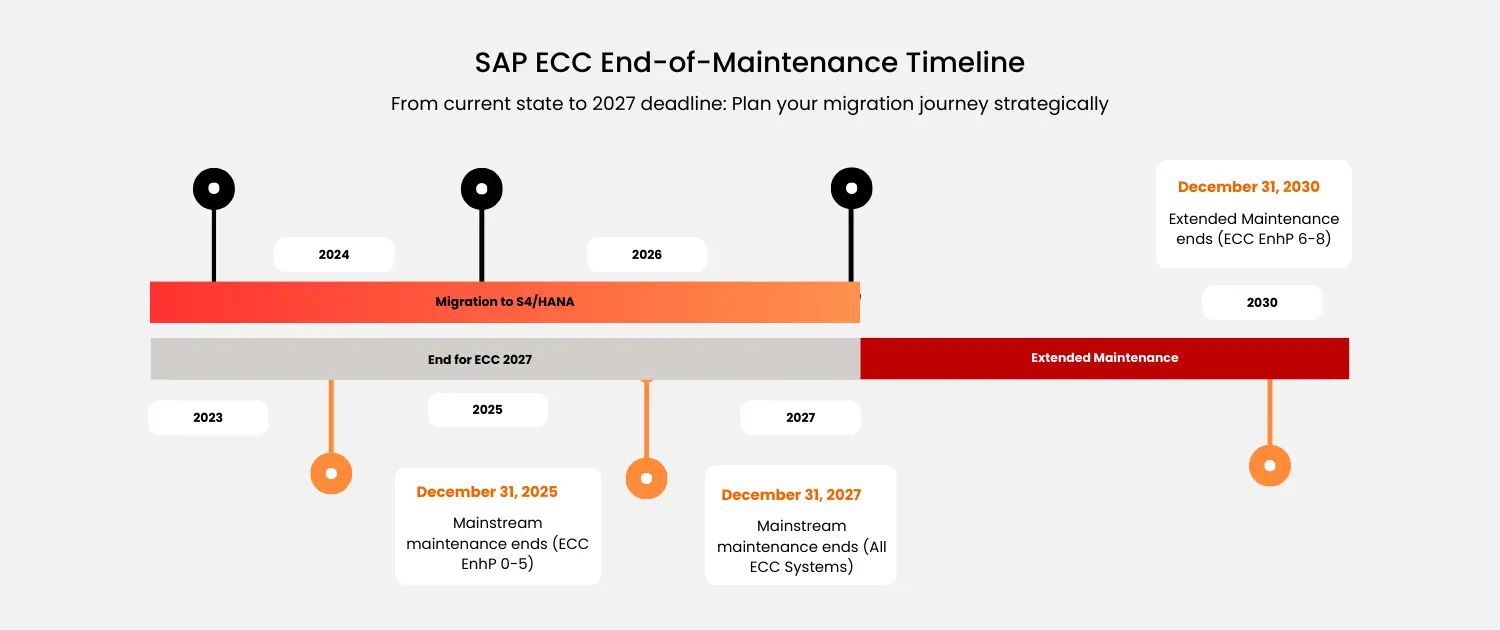
If your business runs SAP, a hard date is now on the horizon. SAP has confirmed that mainstream maintenance for SAP ECC (ERP Central Component, Enhancement Packages 6 to 8) ends on 31 December 2027, with no further extensions. After that date, no new security patches, legal or tax update packages, or bug fixes are delivered unless you pay for extended maintenance. Older enhancement packages (0 to 5) already lost mainstream support at the end of 2025.
What Happens After 2027
The system does not switch off. What ends is the safety net underneath it. Companies then have three practical choices. Buy extended maintenance, which runs to the end of 2030 at roughly a 9 percent premium on annual fees. Move to SAP S/4HANA, the next-generation ERP built on the HANA in-memory database. Or, for select complex customers, extend support to 2033 through SAP's private cloud offering (RISE with SAP).
Why It Is Driving a Cloud Shift
Here is the part that matters for infrastructure teams. A move to S/4HANA is rarely just a software upgrade. It is a chance to rethink where SAP actually runs. Industry surveys suggest a large share of ECC customers have not yet migrated, and full projects typically take 12 to 36 months. That timeline is exactly why planning now matters, because the pool of certified SAP consultants tightens sharply as the deadline approaches.
Many enterprises are pairing the S/4HANA move with a shift off on-premise hardware and onto cloud infrastructure. The reasons are familiar. HANA is memory-hungry, so sizing a physical box for peak load is expensive and inflexible. Cloud lets teams provision certified high-memory instances on demand, run development and test systems only when needed, and place disaster-recovery systems in a separate location without buying a second data centre.
What S/4HANA Brings
Beyond staying supported, S/4HANA offers a simplified data model, real-time analytics on live transactional data, and built-in AI capabilities. For finance and operations teams, that means faster reporting and fewer batch jobs. For IT, it means a smaller data footprint and a cleaner architecture to maintain.
The Takeaway
The 2027 date is not a suggestion. Whether the answer is extended maintenance, a lift-and-shift, or a full S/4HANA transformation, the decision needs to start now. In the community pages this week we look at what running SAP on cloud actually involves, including certified infrastructure and cost.
Comments (0)
No comments yet. Be the first!
Stay Updated
Get the latest tech news delivered to your inbox.